The Accident That Made Life Possible
There is a small fact about water that most of us learn as children.
Ice floats.
It seems ordinary. Almost trivial. You drop an ice cube into a glass and it rises to the top. Nothing remarkable about that.
But if you follow that fact to its logical conclusion, you begin to realize something astonishing.
The fact that ice floats may be one of the reasons complex life exists on Earth at all.
Most Substances Do the Opposite
When most materials freeze, they become denser.
The molecules slow down and pack themselves more tightly together. The solid form sinks beneath the liquid.
If water behaved this way, ice would sink to the bottom of lakes and oceans. Each winter, new layers of ice would accumulate beneath the surface.
Over time, entire bodies of water could freeze solid from the bottom upward.
That would be disastrous for life.
Aquatic ecosystems would collapse every winter. Oceans might eventually freeze over completely in colder climates. The stability of Earth’s climate would change dramatically.
But water behaves differently.
Water Expands When It Freezes
As water cools toward freezing, something unusual happens.
Instead of packing tightly together, the molecules begin arranging themselves into hexagonal crystalline structures. These structures actually take up more space than the liquid form.
The result is that ice is less dense than liquid water.
So it floats.
This small difference changes everything.
Lakes Freeze From the Top Down
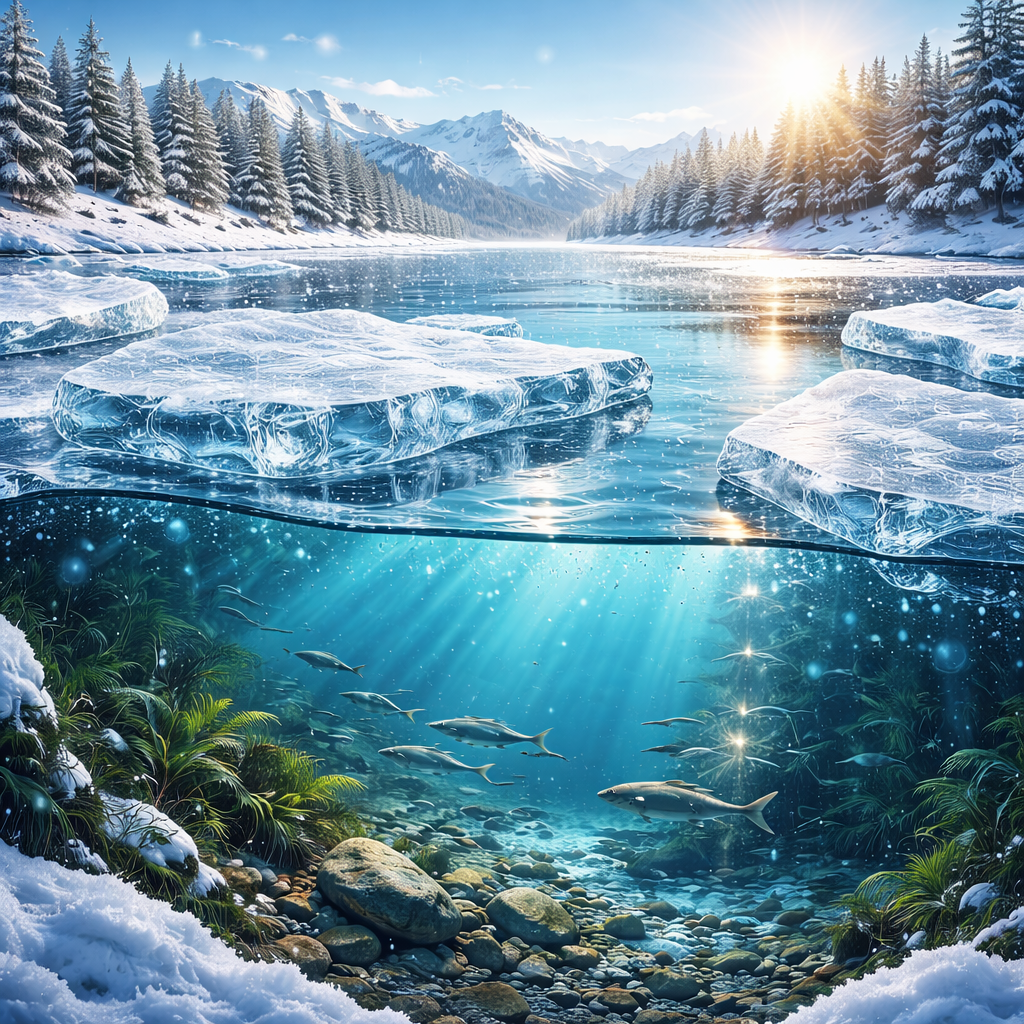
Because ice floats, it forms a layer on the surface of lakes and ponds during winter.
That surface layer acts as insulation. Beneath it, the water remains liquid and relatively stable in temperature.
Fish continue swimming. Microorganisms continue living. Entire ecosystems remain active beneath the frozen surface.
When spring arrives, the ice melts and the cycle continues.
If ice sank instead of floating, those ecosystems would not survive repeated winters.
A Planetary Thermostat
Water’s unusual freezing behavior does more than protect lakes.
It helps regulate Earth’s climate.
The oceans store enormous amounts of heat because water has a high heat capacity. When ice forms on the surface, it reflects sunlight back into space and slows further cooling.
These processes help stabilize the planet’s temperature.
Without them, Earth’s climate might swing between extremes much more dramatically.
A Remarkable Coincidence
Think about how delicate this balance is.
If the molecular geometry of water were slightly different, if hydrogen bonds behaved differently, or if ice were even slightly denser, the entire behavior of water on Earth could change.
And with it, the conditions that allow life to flourish.
This is one of those quiet features of the natural world that hides in plain sight. We see ice floating every day and rarely stop to consider the deeper implications.
Yet this small quirk of physics may be one of the hidden foundations of the living planet.
The Beauty of Simple Things
Sometimes the most important facts about nature are the simplest ones.
A snowflake.
A droplet of water.
A floating piece of ice.
These ordinary things reveal deep truths about the structure of the world.
And occasionally, they remind us that the conditions that allow life to exist are more fragile, and more remarkable, than we usually realize.
Water may be the most familiar substance we know.
But the deeper we look, the more extraordinary it becomes.